
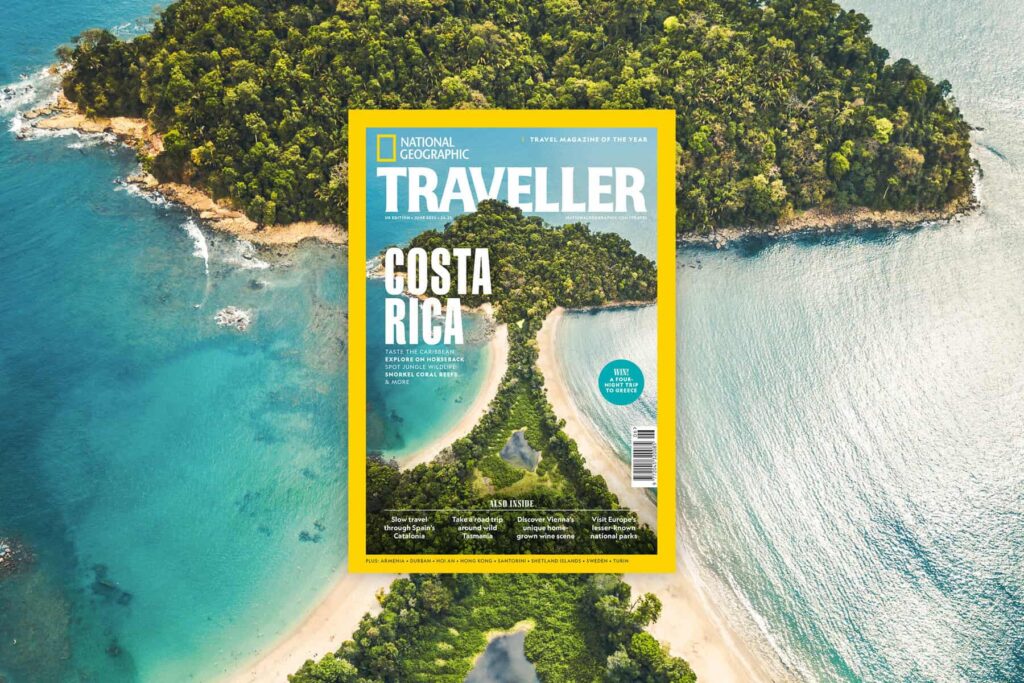
For the June 2026 issue of National Geographic Traveller (UK), I wrote for the Costa Rica: Coast to Coast cover story. Reporting took me from volcanic lowlands to remote beaches, tracing a country where wild ecosystems sit alongside communities working hard to protect their own histories. Three of these features are online now — extracts and links below.
Horse Power: Riding the lowlands beneath Arenal Volcano
At La Finca Lodge, a family-run estate near La Fortuna, horseback tours trade the region’s adrenaline-tourism reputation for something quieter: slow trail rides through sugarcane fields and river crossings, guided by a young horseman whose family has worked this land for two decades. It’s a day that ends, fittingly, in a hidden set of forest hot springs.
“Cantering is the purest connection you can have with a horse,” my guide told me, moments before we broke into a gallop across the volcanic soil.
A Unique Flavour: Cahuita’s Afro-Caribbean kitchens
On the remote Talamanca Coast, a cooking lesson in coconut rice and beans opens a window onto Cahuita’s Jamaican-descended community — its language, music and food forged over more than a century of resilience against political neglect.
“We know our traditions are worth fighting for,” chef Leda Villa Porras told me in her kitchen at Restaurante Las Olas.
Root Cause: The Bribri guardians of Costa Rican cacao
A canoe journey into the Talamanca Mountains leads to Yorkín, an Indigenous Bribri village where a women-led cooperative has spent three decades cultivating cacao by hand — sustaining both a village economy and a way of life that helped shape Costa Rica’s environmental conscience.
“To consume it is a gift from the land,” one villager told me, as he pressed roasted cacao nibs into ribbons of paste.