

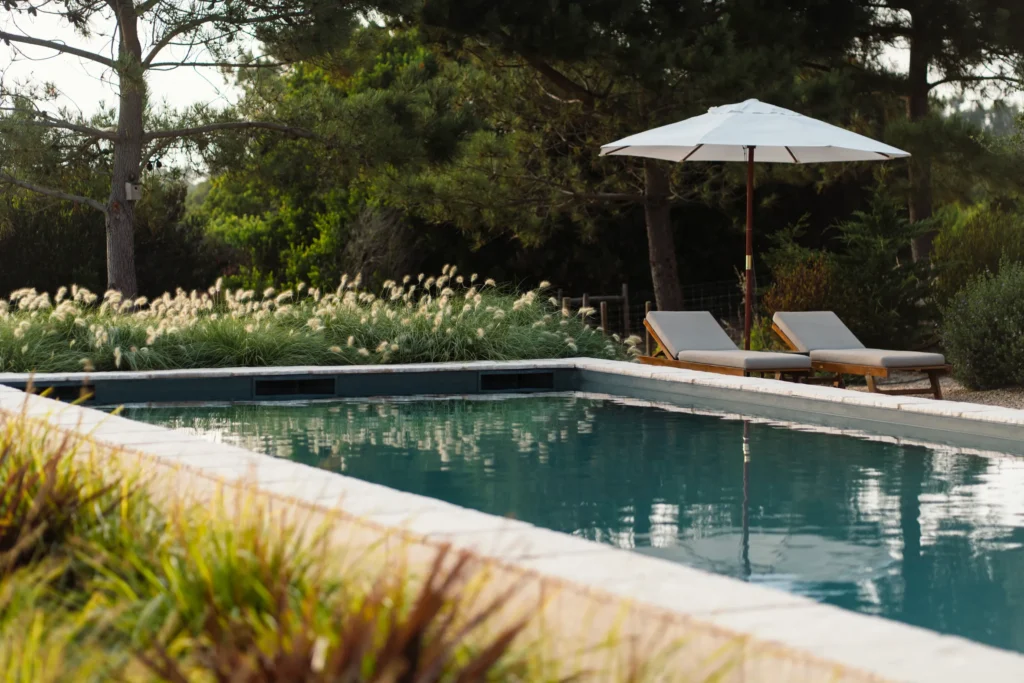
The unspoilt Costa Vicentina is known for surfing and hiking, now it’s making waves with two design-led hotels. Our writer checks in
Read online at thetimes.com
As any good hiker knows, trail etiquette dictates a cheerful greeting for fellow travellers, and there’s no exception among pilgrims in southwest Portugal’s Costa Vicentina, about a 90-minute drive from Faro. “Almost there!” one encourages me, struggling with his backpack. “Gorgeous day,” huffs another.
They’re heading over wildflower-strewn headlands and wave-pounded beaches towards hostel bunk beds in a fishing village, where I imagine they’ll compare blister treatments over communal pasta. I give them a comradely thumbs-up and watch them go, then turn down a different path entirely. One that ends, as it happens, at a rather good sauna.
Eschewing both the long-distance trails and surf breaks for which this pristine, nearly 70-mile coastline is best known, I’ve instead come to enjoy two pioneering new hotels at the western edge of the Algarve. Amaria, near the village of Odeceixe, and Vale Palheiro Earth Resort, just under nine miles south, outside the town of Aljezur, represent the first upmarket boutique propositions in the Southwest Alentejo and Costa Vicentina Natural Park for travellers who prefer their wilderness to come with a high thread count.
“When I arrive from Lisbon, come down the valley and see this, I just exhale,” Madalena Rutkowski says, dropping her shoulders for effect. “I fall in love with the place all over again.” Rutkowski is an architect and she and her husband, Pedro, are behind Vale Palheiro. It took them 14 years to realise the 13-key retreat with a mix of suites, casitas and villas which opened in August last year. “This part of Portugal has been a well-kept secret for a long time. Preserved by its natural park status, now people are definitely getting curious,” she says.
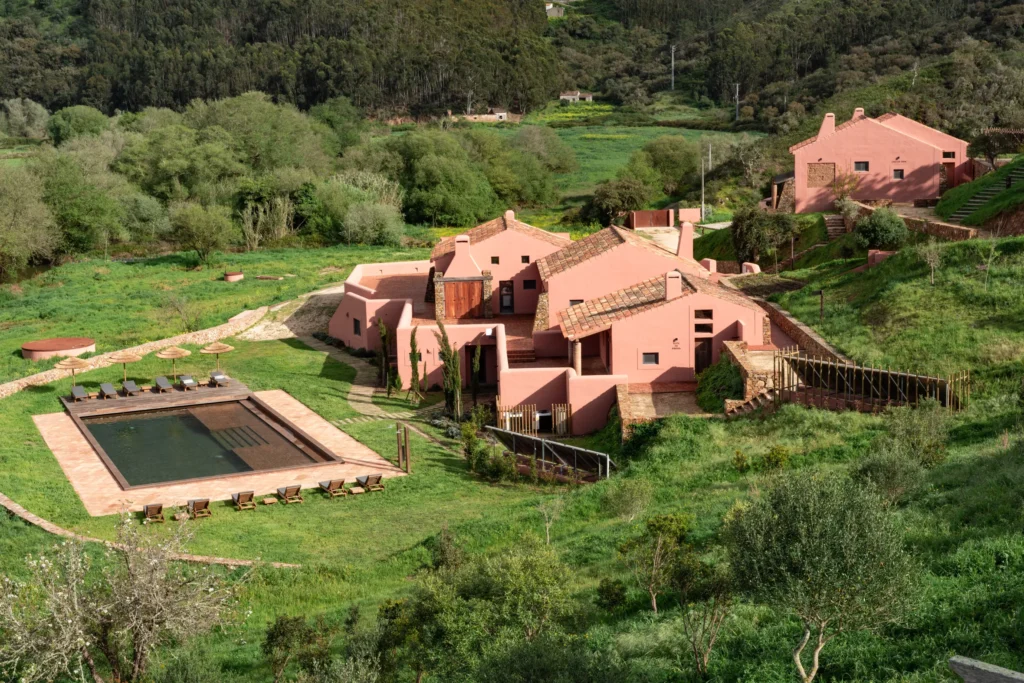
The approach to the property is indeed gorgeous. Exiting the narrow lanes of Aljezur onto a bumpy track, the resort ahead could be a trick of the shadows in an emerald valley snaking towards the sheen of the ocean. Drawing closer, it looks as if the couple have created a hamlet: a charming jumble of ochre walls, chimneys, schist stonework and aged terracotta tiles, built into the slope. A dark saltwater pool awaits in a lush lawn, not far from a stream; beyond the stables and chicken coop, goats and sheep are tending to a pasture.
“It was important to us to create something in harmony with the landscape, that feels like it was always here,” Rutkowski explains, justifying her ambitious decision to build with the dying regional technique of taipa — using rammed earth for construction, a style dating back millennia. “It was hard to find the right artisans,” she confesses. The property shows off its ecological bones with artistic cut-outs in the painted plaster, the russet taipa walls revealed, flecked with pebbles and roots.
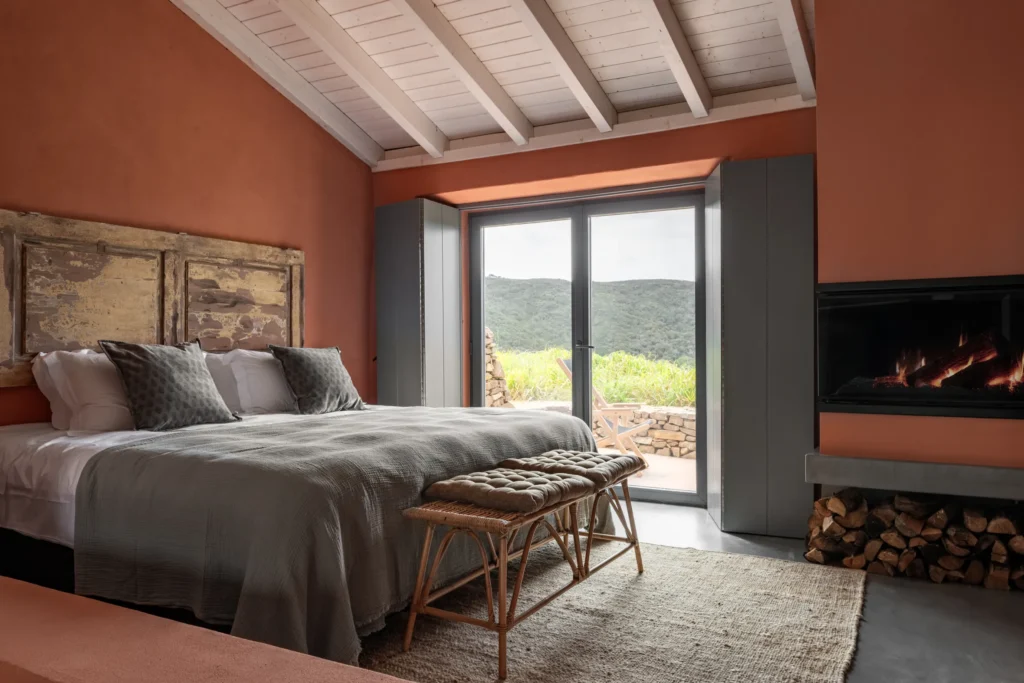
I check into my duplex villa, which is vast — more like a hayloft than a hotel room. A sunken lounge with a fireplace leads out to a terrace with sweeping views east, the 12th-century ruins of Aljezur castle in the distance. A double-height reception area offers a neat kitchenette — microwave, fridge, earthenware crockery — should I wish to whip up something with produce from Aljezur’s market. On the mezzanine, an ample bed spread with crisp Portuguese linens faces onto a roomy glass shower.
The decor embraces the organic: granite-hued microcement floors retain phantom swirls of craftsmanship, as do the lightly textured walls. Antique sideboards and knotted rugs give the space a lived-in feel. Otherwise, the lines are contemporary: industrial-chic shutters, crisp white rafters. The same is true of the Barn restaurant, at the heart of the property, where a focused menu rotates with the seasons, and the small spa with a sauna and treatment room below it. “Every window and door frames the landscape like a picture,” Rutkowski says.
A love letter to the land
A 20-minute drive away, and opened in July 2023, the white farmhouse complex that makes up Amaria is pure Mediterranean daydream. Eleven sun-filled suites and one three-bedroom apartment gaze through diaphanous drapes and walls of glass onto a landscaped wilderness woven with nooks: a yoga deck, a fire pit, an outdoor summer kitchen; a vegetable garden and an organic vineyard, too, now producing its first vintages. The ocean is at the periphery, beyond tall cliffs — an idyllic backdrop to the lap pool, tucked into a glade and burnished every sunset.
“I’ve lost track of how many trees I’ve planted; perhaps 2,000,” Nuno Oliveira tells me on a walk through the rewilded property he bought a decade ago. “And 8,000 plants. What you put in the land here, it grows.” Like Vale Palheiro, Amaria sits atop the ruins of a humble farm — it was that blueprint of existing foundations that enabled Oliveira, previously a mechanical engineer in Lisbon, to build something new within the natural park. Impressive environmental technologies, from solar panels to cork insulation, still had to be employed, but they’re not something you’d ever notice as a guest.
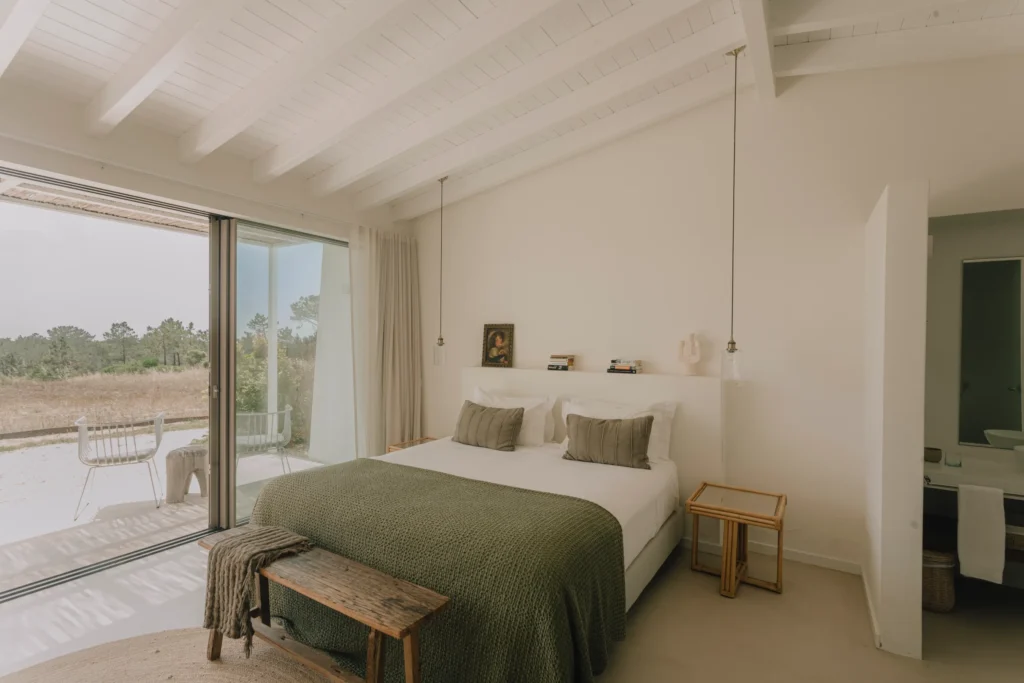
There’s a simplicity to the design, but the effect is luxurious. The indoor communal spaces — the Library and Cantina — have perfected a pared-back, contemporary aesthetic that also borrows from old country estates: white walls are a soothing canvas against which antiques, deep sofas, interior design volumes and vases of foliage add personality. When the afternoon sunlight casts soft shadows, it feels like a still life painting. My bedroom is all muted elegance, with a freestanding tub, a wood-burning stove and a garden-level patio from which to soak up the views.
“Here, you feel completely at home yet disconnected from the world,” Oliveira says, with the contented smile of a man who’s left the hustle of city life behind him. His British wife, the former fashion editor Phoebe Arnold, oversees the restaurant. Playing hostess from the open-plan kitchen, she whips up cakes and presses drinks into hands, offering recommendations for exploring the area, all while creating each day’s menu from scratch, based on the best local produce.
Dinner is a convivial, candlelit affair where conversation sparks between tables. We feast on burrata and clementines, beef carpaccio with capers, and sea bream with asparagus and beurre blanc — all sourced on site or within a few miles. At some point Arnold brings round a bottle of medronho, Algarvian spirit — it all gets a little hazy after that. On warm evenings, these dinners move outside under the stars; chef collaborations, yoga lessons and ceramics workshops are all on the summer schedule too.
Breakfast the next morning is everything from poached pears to fresh pastries. Outside, the hotel is blissfully quiet but for birdsong and the hiss of the ocean. The sauna is also being fired up for me — a spectacular glass-backed affair that gazes out across forested cliffs and hidden hiking trails to the endless Atlantic — delivering what I suspect might be Portugal’s most scenic hangover cure.
Amelia Duggan was a guest of Vale Palheiro Earth Resort, which has B&B doubles from £206 (valepalheiro.com), and Amaria, which has B&B doubles from £181 (amaria.pt). Fly to Faro.
Exploring Aljezur and the Costa Vicentina
What to see and do
In a region of tranquil and sparse communities, the cultural epicentre of the Costa Vicentina is Aljezur, a whitewashed town with its roots in the 10th century. The remains of a Moorish castle sit brooding atop a hill; for historians, the small Museu Municipal (£2; cm-aljezur.pt) has a room devoted to the region’s 500 years under Islamic rule, which ended in the mid-13th century.
Stop at the noticeboard outside the funky Moagem café (@moagem_aljezur on Instagram) to pick up flyers for reiki, shamanic breathwork, family constellations and more — Aljezur has long been home to an alternative community of free spirits. Rub shoulders with them over oat flat whites at Koyo (koyospecialitycoffees.com), vegan fare at Roots (from £4; @roots_aljezur on Instagram) and fresh pizzas at Arte Bianca (from £8; artebianca.pt).
On Saturday mornings, a great little farmers’ market in front of the church in the New Town brings the community together in a celebration of Algarvian produce, from herbs and honey to sourdough and sweet potatoes. The last are so prized they’re practically the town mascot; they’re celebrated each October/November harvest with three raucous days of cooking and live music (festival-batatadoce.cm-aljezur.pt).
The hiking trails of the Rota Vicentina lace this region together, travelling between sandy clifftops, pine forests and sleepy villages on waymarked routes suited to all levels of experience, so packing walking shoes is a must (rotavicentina.com). The 13-stage Fisherman’s Trail hugs the coast most closely, with Arrifana’s black schist cliffs and the crescent beach at Odeceixe among its most dramatic passages.
These are some of Portugal’s most striking beaches: hit the waves with Arrifana Surf School (two-hour group lesson from £46pp, including board and wetsuit; arrifanasurfschool.com) or try stand-up paddling on the glassy Seixe River just before it spills into the ocean at Odeceixe beach (£9 an hour for board hire; water-element.pt).
For those who prefer to experience nature from the saddle, Carrapateira Extreme runs horse rides through the dunes and over the vertiginous cliffs around Carrapateira village, with storytelling from the guide Nelson Inacio, who spent his boyhood exploring the area (one-hour tours from £52pp; carrapateiraextreme.com).
Take it up a notch with Natura Tours, who run four-wheel-drive excursions into the forested Monchique mountains or to Cabo de Sao Vicente, continental Europe’s southwesternmost point, where the sunset draws a small, reverent crowd each evening (four-hour tours from £39pp; naturatours.pt).
At Monte Clerigo beach, Rock and Reel’s 90-minute tidepool safaris are a reliable hit for families, offering insightful interactions with the octopuses, anemones and periwinkles that colonise the shore’s rocky platforms at low tide (90 minutes from £26pp; rockandreelfishing.com). The ocean guides Cristian Perez and Marzena Saka are brilliant teachers and can also take groups out to a spray-blasted islet for a half-day of traditional Portuguese line fishing (four hours from £103pp; rockandreelfishing.com).
Where to eat
CAL, Arrifana
The chef Susana Felicidade grew up watching her grandmother run a seaside restaurant; she went on to build a Lisbon empire before returning in 2022 to open her own atop the sheer cliffs of Arrifana. CAL’s sea-view terraces, framed by low whitewashed walls and animated by a cast of surfers, make the setting hard to fault. The cooking’s just as good — sharing dishes rooted in local produce, chalked up on blackboard menus. Favourites include the cuttlefish stew and the razor clams served with creamy rice (mains from £17; @cal.arrifana on Instagram).
O Sargo, Monte Clerigo
With its dune-blotted beach and cascade of paintbox cottages, the hamlet of Monte Clerigo looks like an unlikely candidate for a lively night out, but O Sargo serves just that. Live music on Tuesday and Friday evening lights up the laid-back restaurant-bar, where sun-bleached decking, an outdoor grill and funky Edison bulbs give the impression of a grown-up surf shack. The seafood-forward menu is at its most fun when riffing on Asian dishes like nasi goreng fried rice and tuna tataki with ponzu-dressed salad (mains from £14; restauranteosargo.pt).
Pont’a Pe, Aljezur
A beloved Aljezur institution that specialises in Portuguese fare done well, Pont’a Pe is all about regionality — tender octopus on sweet potatoes, stewed black pork cheeks and a steamed seafood cataplana served in a traditional copper clamshell pot are some of the house specials. A century back, this was a riverside inn catering to merchants; with its exposed rafters and rustic decor, little seems to have changed (mains from £13; pontape.pt).
Where else to stay
Praia do Canal Nature Retreat, Vale dos Polvos
The only other high-end proposition within the Southwest Alentejo and Costa Vicentina Natural Park, Praia do Canal arrived on the scene in 2022. With 56 rooms across a 220-hectare private estate, it operates at a different scale to its neighbours yet manages to retain a sense of soul. Low sand-hued buildings seem to rise organically from the scrubland; inside, driftwood, hewn stone and locally sourced materials keep things grounded. At the sleek flagship restaurant Azeitona, ingredients do all the talking — as with the standout dish of purple prawns with ajo blanco, almonds, grapes and malagueta chilli (B&B doubles from £207).
The Lemon Lodge, Aljezur
The collective dream of two Dutch couples who converted a traditional farmhouse near Aljezur, the Lemon Lodge is entirely off-grid — solar-powered, well-watered, wood-fired — and run according to permaculture principles. Two rustic-chic suites (a double and a family room sleeping four) each have a fireplace, open-plan kitchen and valley-facing terrace. The more adventurous can opt for a secluded glamping set-up for two with an outdoor kitchen and natural pond. Check the schedule for yoga, cold-water immersion and healing workshops (room-only doubles from £49).
Aldeia da Pedralva, Vila do Bispo
Two decades ago, this rural hamlet near Vila do Bispo had nine remaining inhabitants and 50 houses collapsing into ruin. Rather than let it disappear, the new owner embarked on a painstaking restoration using traditional techniques. The result — 24 comfortable one to three-bedroom cottages arranged along cobbled lanes — is an unhurried community, presided over by a restaurant serving rural classics including bacalhau and black pork skewers (room-only doubles from £52).